'%3e%3cpath%20fill='white'%20d='M12.2178%205.26343L15.3569%2012.7053L17.4812%2010.5404L12.2178%205.26343Z'%3e%3c/path%3e%3cpath%20fill='white'%20d='M5.27696%2022.7721L22.7721%205.27696L17.4951%200L0%2017.4951L5.27696%2022.7721Z'%3e%3c/path%3e%3cpath%20fill='white'%20d='M12.2178%205.27696L29.7129%2022.7721L34.9899%2017.4951L17.4947%200L12.2178%205.27696Z'%3e%3c/path%3e%3cpath%20fill='white'%20d='M54.9618%206.25116C55.4353%204.70867%2055.8413%203.38266%2056.2201%202.05666H56.3419C56.7478%203.40972%2057.1267%204.76279%2057.695%206.31881L60.0087%2013.8013H52.5533L54.9618%206.25116ZM54.3529%200.270613L47.1816%2022.4068H49.766L51.8227%2015.9662H60.7258L62.7825%2022.4068H65.4886L58.2768%200.270613H54.3529ZM79.2764%2022.4474H81.8066V2.55729H87.6789V0.270613H73.4041V2.5167H79.3034L79.2764%2022.4474ZM100.181%2022.4474H102.711V0.270613H100.181V22.4474ZM119.408%2011.271C119.408%204.38393%20121.749%202.27315%20125.348%202.27315C128.947%202.27315%20131.41%204.57336%20131.41%2011.5011C131.41%2018.4288%20129.11%2020.4989%20125.443%2020.4989C121.776%2020.4989%20119.408%2018.1852%20119.408%2011.271ZM133.994%2011.271C133.994%203.15264%20130.774%200%20125.524%200C120.274%200%20116.702%203.31501%20116.702%2011.5011C116.702%2019.6871%20119.895%2022.7721%20125.172%2022.7721C130.449%2022.7721%20133.94%2019.4571%20133.94%2011.271H133.994ZM152.937%2020.4989C150.862%2020.5138%20148.851%2019.7732%20147.281%2018.4152L145.793%2020.4313C147.733%2022.0331%20150.193%2022.8661%20152.707%2022.7721C157.443%2022.7721%20160.095%2019.9983%20160.095%2016.6427C160.095%209.87738%20149.541%2010.8922%20149.541%205.81818C149.541%203.80211%20151.084%202.3408%20153.681%202.3408C155.259%202.31464%20156.794%202.85197%20158.011%203.85624L159.554%201.89429C157.923%200.632155%20155.905%20-0.0274889%20153.844%200.0270606C149.866%200.0270606%20146.984%202.61141%20146.984%205.96702C146.984%2012.9488%20157.538%2011.8123%20157.538%2016.7915C157.443%2018.8482%20155.833%2020.4989%20152.829%2020.4989H152.937Z'%3e%3c/path%3e%3c/g%3e%3cdefs%3e%3cclipPath%20id='clip0_1060_39'%3e%3crect%20fill='white'%20height='22.7721'%20width='160'%3e%3c/rect%3e%3c/clipPath%3e%3c/defs%3e%3c/svg%3e)
 Christina
On this page
You will need these basic components for a KNX system, that are usually installed in your electrical cabinet:
- KNX Power Supply: Powers the KNX bus
- KNX IP Interface: Is used to program your KNX system with the ETS software
- KNX Actuators: Switching or blind actuators for example. They receive signals from sensors and wall switches, and control lights, blinds, and heating.
- KNX-DALI Gateway: If you want to integrate smooth dimmable lighting, or tunable white or color lights, this is the modern way to go. It translates KNX commands into DALI (Digital Addressable Lighting Interface) commands for DALI compatible Lights.
Additionally to control all your Lights, Blinds, and more, you will add the following devices to your KNX System
- KNX Sensors: Wall switches, Motion detectors, temperature sensors or entire weather stations. These are installed throughout the house.
- App Server: Not strictly necessary, but required if you want to control your KNX devices from an App or by Voice
An example image of a typical KNX installation
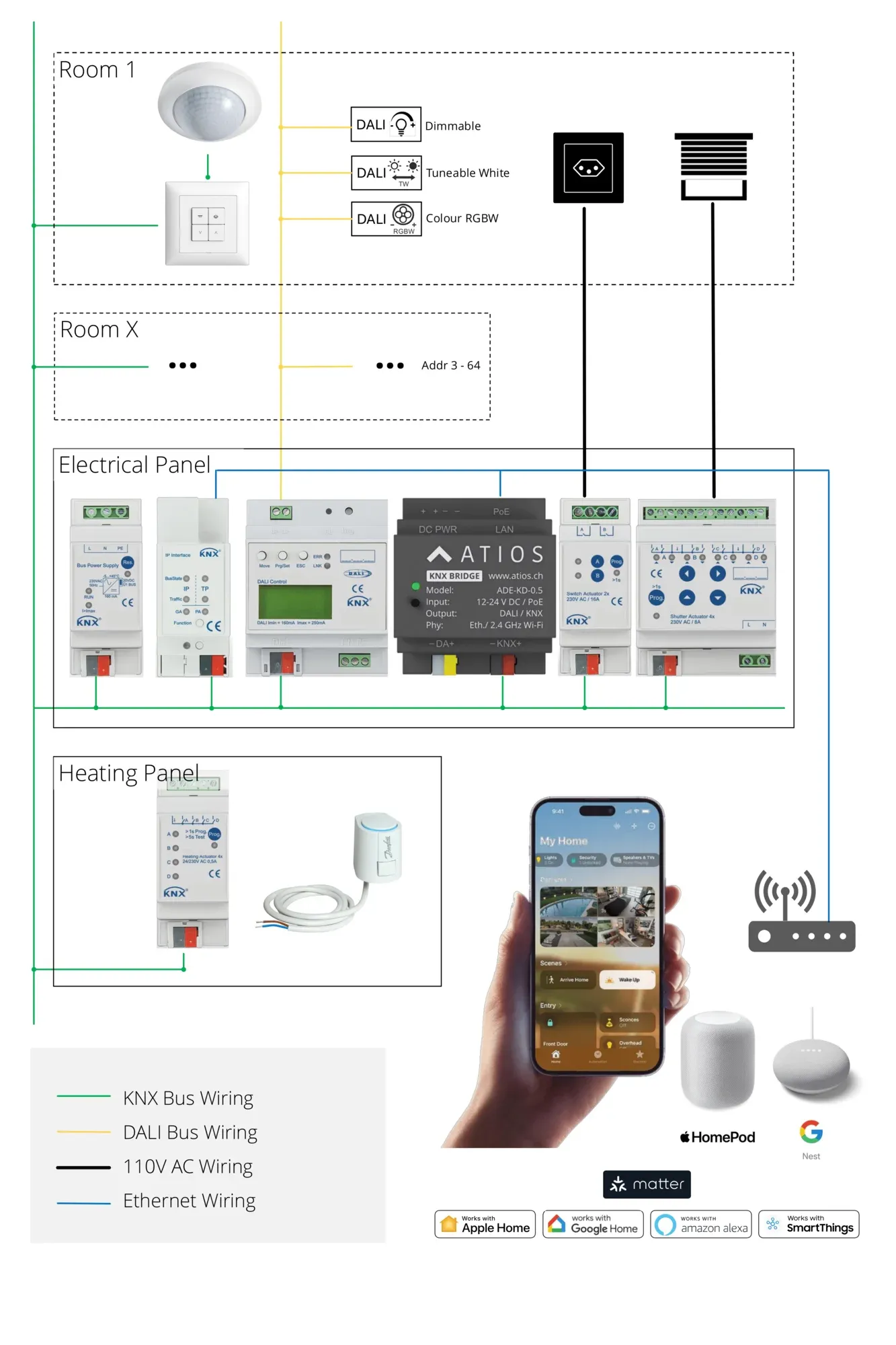
In the rooms: Sensors like motion detectors and KNX switches send signals on the KNX bus (green) to control lights, blinds, and outlets. The Lights in the rooms are in this case dimmable DALI lights that are connected with a DALI bus wire (yellow). And the switchable power outlets and motorized blinds are connected via 110-240VAC wires (black) to the actuators in the electrical cabinet.
In the electrical panel: Several KNX devices line up on the DIN rail: power supply, IP interface, KNX-DALI Gateway, an App Server - in this case Atios KNX Bridge, and actuators for switching and driving motorized blinds.
In the heating panel: A KNX heating actuator controlling heating valves. Since there are usually many valves for different heating zones throughout the Home, and all valves need to be wired to the actuator outputs, it makes sense to install this actuator directly in the heating panel to reduce wiring.
Control options: Atios KNX Bridge, the App Server that we suggest you to use, allows the entire KNX System consisting of Lights, Blinds, Thermostats, Doors etc. to be controlled via Matter compatible apps such as Apple Home, Google Home, Amazon Alexa, Home Assistant, Samsung SmartThings and many more. Each of these systems offers voice control options such as Siri.
Benefits of using Atios KNX Bridge as your App Server
Besides allowing control of KNX devices via Matter compatible apps, Atios KNX Bridge can actually serve in total as 3 devices from your KNX system. Instead of traditionally buying and installing these 3 devices:
- KNX IP Interface (~€200)
- KNX DALI Gateway (~€400)
- App Server (~€500)
One can now install a single Atios KNX Bridge (499€) and also profit of the following advantages:
- Matter apps such as Apple Home have highest user satisfaction
- Saves ~600 EUR in hardware costs
- Frees up DIN-rail space, import for small electrical cabinets
- One device = one configuration, fewer failure points, and simpler troubleshooting
- Unified firmware updates
Because the Bridge combines KNX IP interface, KNX-DALI gateway and App Server in one, setup is simple and fast, the cabinet stays tidy and maintenance is easy. Instead of three devices that each need wiring and configuration, you get a single controller that exposes your KNX system to the most user-friendly apps on the market.
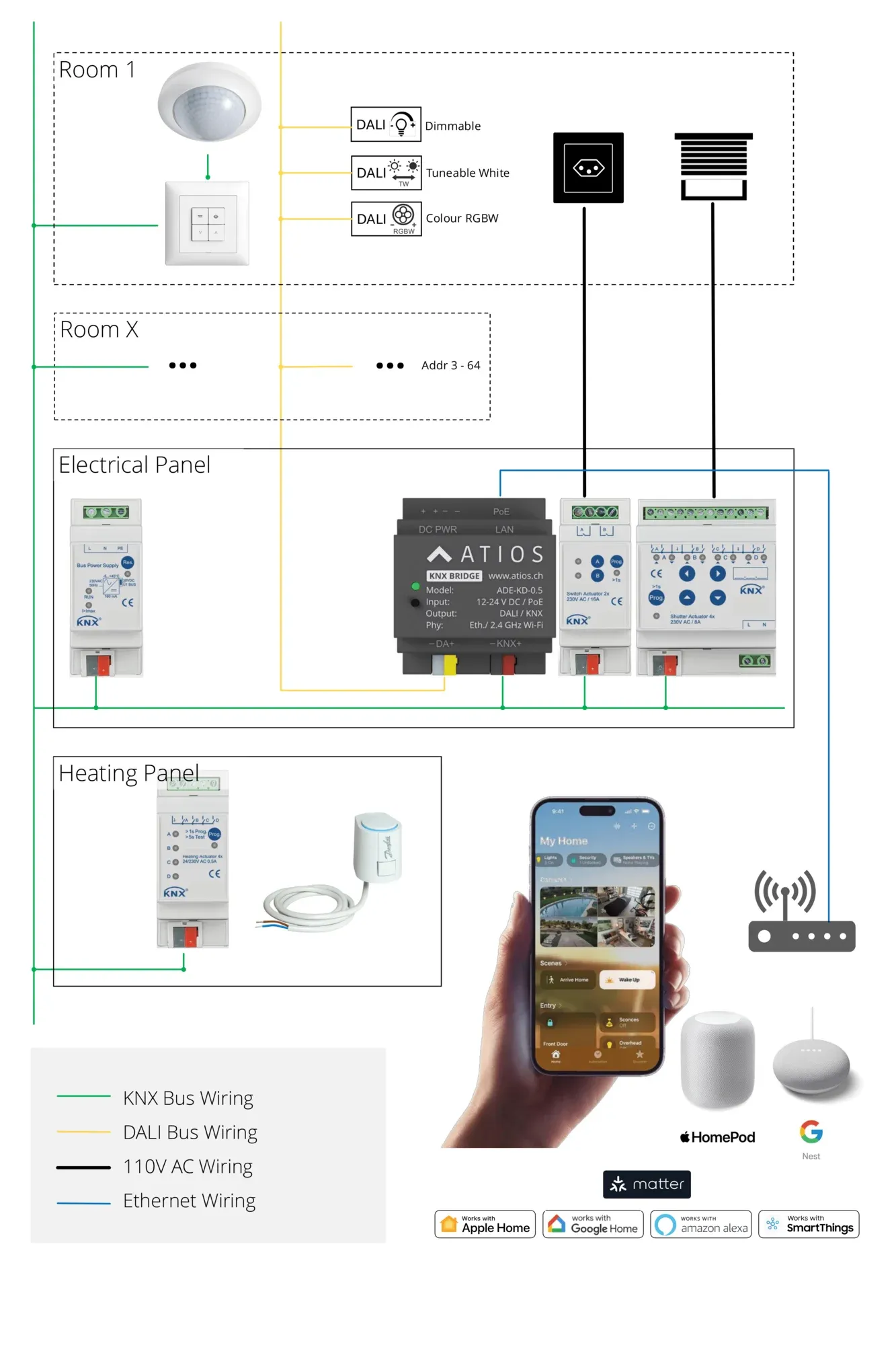
The same topology example of a KNX system from above, is now reduced by using all functionalities of Atios KNX Bridge:
The Bottom Line
Atios KNX Bridge lets you keep all the advantages of your wired KNX system: reliability, stability, long product lifetimes - while removing the one thing homeowners usually complain about: the outdated user experience. Instead of separate boxes for IP interface, DALI gateway, and app control, a single compact device brings your entire KNX system into Apple Home, Google Home, Alexa, SmartThings, Home Assistant and more, all via Matter. You cut cabinet space and configuration work, yet end up with a system that is easier to use, easier to maintain and far more future-proof for the next decades.
Continue reading
Why Are We Passionate About Matter?
An engineering team’s honest answer.

You Designed the Customer Journey. Don’t Forget the Staff Journey.
A retail automation system is only as good as the experience of the people who use it every day.

The Home Office That Feels Like a Porsche Cockpit
Lighting, climate, one gesture.